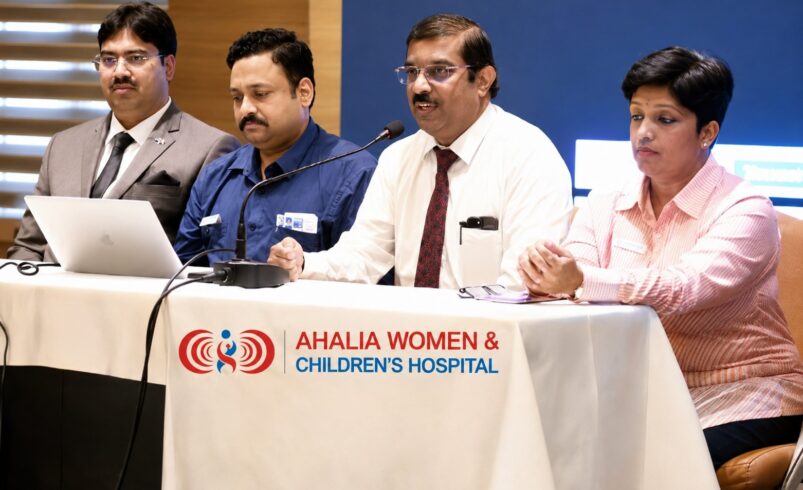
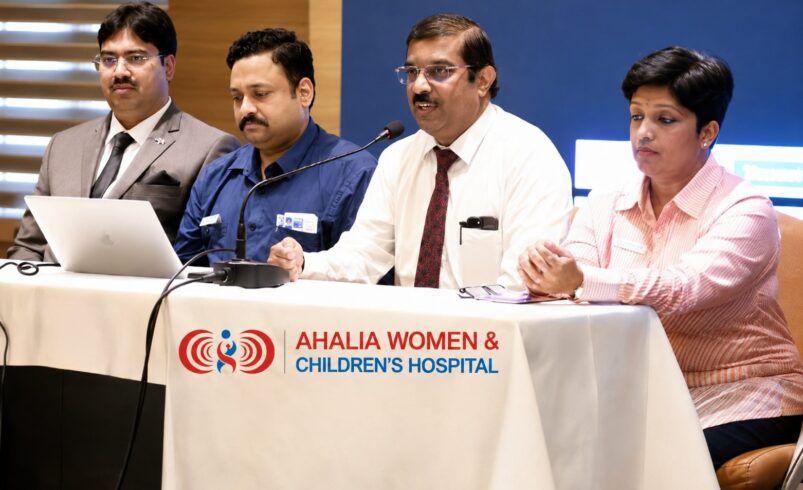
Palakkad, Kerala, India, July 30, 2026- Historical past Created at Ahalia Ladies & Kids’s Hospital- India’s. How lengthy does a new child child often stay in a Neonatal Intensive Care Unit (NICU)? Most infants are discharged inside just a few days, whereas some critically unwell newborns could require just a few weeks of intensive care. Nevertheless, child Amaana has spent the primary 1 yr of her life within the NICU at Ahalia Ladies and Kids’s Hospital, making her journey considered one of extraordinary resilience, perseverance, and hope.
Amaana was referred to Ahalia NICU shortly after delivery with bilious vomiting. Emergency analysis led to an exploratory laparotomy by Pediatric Surgeon Dr. Muthulingam, which revealed an exceptionally uncommon and extreme congenital intestinal abnormality- ‘Sort IV Ileal atresia’. The newborn had solely 5 to 6 brief segments of ileum. Following meticulous reconstruction, preserving each potential phase of bowel, the full remaining ileal size was solely roughly 15 cm, in contrast with the traditional neonatal ileal size of 150–180 cm. In the course of the first month of life, she required two extra stomach surgical procedures.
Submit-operatively, this child was managed in Ahalia Degree III NICU by Neonatologists Dr Padmesh Vadakepat (Head of the Division) and Dr Rathnapratheep (Guide). The newborn subsequently developed Quick Bowel Syndrome with Intestinal Failure, a life- threatening situation by which the gut is unable to soak up enough vitamins and fluids.
Even minimal feeds resulted in vomiting or profuse watery stools with nearly no absorption. Regardless of a number of evidence-based feeding methods, she remained depending on Whole Parenteral Vitamin (TPN) the place all vitamins together with carbohydrates, lipids, proteins, micronutrients are administered via a central venous catheter. All through these 11 months, specifically formulated TPN options have been ready underneath strict aseptic situations in a laminar airflow chamber by the devoted NICU nursing crew.
All through this extended and difficult journey, Amaana displayed outstanding dedication. Equally inspiring was the unwavering religion and resilience of her mother and father, who stood by each medical determination and raised monetary assist via crowd funding to satisfy the large therapy bills.
The medical crew sought knowledgeable opinions from a number of main pediatric surgical centres throughout India. Given the complexity of the situation, there have been no extra surgical choices supplied inside the nation at the moment.
Throughout this seek for options, the crew established contact with two internationally famend pediatric surgeons—Dr. Basem A. Khalil, a British Pediatric Surgeon primarily based in Dubai, and Dr. Saleem Mammoo, primarily based in Qatar—each internationally recognised for his or her experience in Serial Transverse Enteroplasty (STEP) and superior intestinal lengthening procedures. Following a number of digital discussions, each surgeons graciously agreed to travelto India to function on the kid. Nevertheless, one other main problem lay forward. For the reason that surgeons have been overseas nationals, acquiring momentary medical registration from the Nationwide Medical Fee (NMC) was important earlier than surgical procedure might be carried out. The approval course of prolonged over almost three months and concerned intensive correspondence and representations to a number of authorities.
Simply because the regulatory approvals have been nearing completion, worldwide journey disruptions associated to the battle within the Center East triggered additional delays within the surgeons’ arrival.
Regardless of these unexpected obstacles, the Intestinal Lengthening Surgical procedure (STEP/MASTEP) was finally carried out efficiently when the infant was 11 months previous, at Ahalia Ladies and Kids’s Hospital by Dr. Basem A. Khalil, Dr. Saleem Mammoo, and Dr Muthulingam, ably supported by the Anaesthesiology Division and OT Employees. Submit-operative interval was uneventful with out problems.
Dr Padmesh defined that the result has been extremely encouraging. Amaana has now been efficiently weaned off TPN for 3 days every week, is tolerating 120–150 ml of milk each three hours, and has begun taking strong meals. She continues to make regular progress and, though she nonetheless requires ongoing hospital care and dietary rehabilitation, she is now firmly on the trail in direction of restoration.
This landmark process represents the primary reported efficiency in India of STEP with Modified Angular STEP (MASTEP) involving the duodenum, providing new hope for kids with extreme brief bowel syndrome and intestinal failure. It demonstrates that superior intestinal rehabilitation procedures can now be efficiently carried out inside India, probably remodeling the outlook for infants who beforehand had extraordinarily restricted therapy choices.
The profitable administration of child Amaana displays the facility of multidisciplinary teamwork, parental belief, worldwide collaboration, and unwavering dedication to offering superior care for kids with essentially the most complicated medical situations.